
 Black tea · Malty breakfast tea
Assam
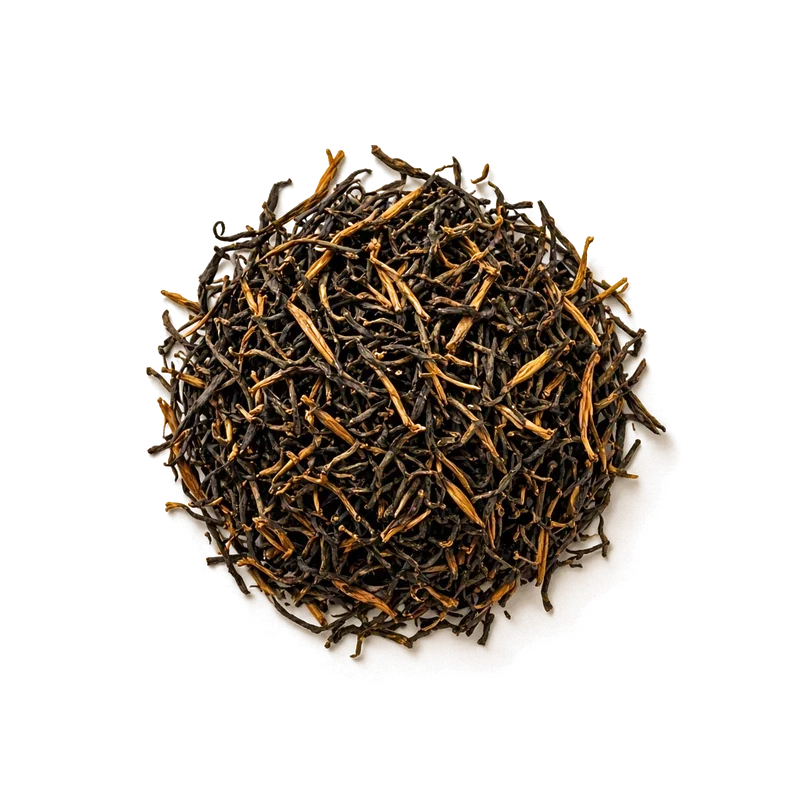
Second flush Assam is the classic loose-leaf style
8.8/10 editor's score
Strong, malty black tea from the hot, wet lowlands of the Brahmaputra valley in north-east India. The heart of most breakfast blends, and at its best in the golden-tipped second flush.
Based on published sources, not yet tasted.
What you need
At a glance
Strong, malty black tea from the hot, wet lowlands of the Brahmaputra valley in north-east India.
About Assam
What sources say about the taste
Sources describe Assam as the definition of a "malty" tea: a full body, brisk strength and honeyed sweetness, with a deep red cup that stands up to milk and sugar.
First sip
Lift the cup and smell before you drink.
Middle
Let it sit on the tongue for a moment.
Finish
What stays after you swallow.
Notes and intensities are an editor's summary of published tasting notes, not our own tasting.
Where it grows
History and culture
The tea plant grows wild in Assam. In 1823 Robert Bruce was shown wild tea plants used by the local Singpho people, and the British went on to build a tea industry there 1.
The Assam Company was founded in 1839, the first British company to grow tea commercially in India. Today Assam is one of the largest tea-growing regions in the world 1.
Editor's score
Weighted across six criteria: flavour 30%, heritage 20%, availability 15%, value 15%, beginners 10%, versatility 10%.
Based on published sources, not yet tasted. Rates the tea style, not a brand. How we score →
Taste profile and caffeine+
Profile is an editor's summary of published tasting notes, not a lab measurement or our own tasting.
Caffeine
Our estimate: Assam is a strong black tea and is usually brewed hot and long, which pulls more caffeine. Per 8 fl oz (240 ml) cup. Coffee and tea averages from Mayo ClinicC.
Harvest calendar+
Assam picks for most of the year, with a winter break. Second flush is the best known 1. Tap a month or a season.
Cultivars and plant+
Assam tea is made from Camellia sinensis var. assamica, the large-leaf variety that suits the hot, wet lowlands 1.
Modern gardens use many clonal cultivars, including the Tocklai (TV) series bred by the Tocklai Tea Research Institute in Jorhat.
How it is made+
Leaf is softened on troughs with moving air.
Full oxidation develops malt and colour.
Fired to stop oxidation.
Graded by particle size.
Dry leaf and liquor+
The colour swatch is an approximate guide, not a photograph.
Food pairings and storage+
Works well
- Full English breakfast
- Buttered toast and marmalade
- Fruit cake, ginger biscuits
- Mild curries
Best avoided
- Delicate fish
- Light, floral desserts
Pairings are general suggestions from the tea's style, not tested matches.
Storage
- Airtight, opaque tin or pouch, away from light, heat, moisture and strong smells.
- Keep it out of the fridge unless fully sealed, to avoid condensation.
- Most loose tea is at its best within a year. Note the harvest date on the tin.
Grades and fakes+
Orthodox Assam uses the leaf grades: TGFOP and FTGFOP for whole leaf with golden tips, BOP and GBOP for broken leaf. CTC grades such as BP and PF are for tea bags 2.
"Tippy" means plenty of golden buds, a sign of careful plucking.
How to spot a poor or fake one
- Look for an estate name and "orthodox" for loose leaf.
- Golden tips should be real buds, not dust.
- Very cheap "Assam" may be a mixed blend.
FAQ+
Is Assam stronger than English Breakfast?
English Breakfast is usually a blend that often contains Assam. Pure Assam is typically just as strong, and maltier.
Does Assam need milk?
It does not need it, but its body and malt hold up well to milk and sugar.
What does "malty" mean?
A rich, bready sweetness, like malted barley or malt loaf.
Sources
- Wikipedia, "Assam tea". en.wikipedia.org/wiki/Assam_tea
- Wikipedia, "Tea leaf grading". en.wikipedia.org/wiki/Tea_leaf_grading
- Tea Board of India. www.teaboard.gov.in
- Mayo Clinic, "Caffeine content for coffee, tea, soda and more". www.mayoclinic.org/healthy-lifestyle/nutrition-and-healthy-eating/in-depth/caffeine/art-20049372
Scores and content updated 30 Oct 2026.